WVU Medicine Advances Robotic Reconstructive Urology with Surgical Milestone
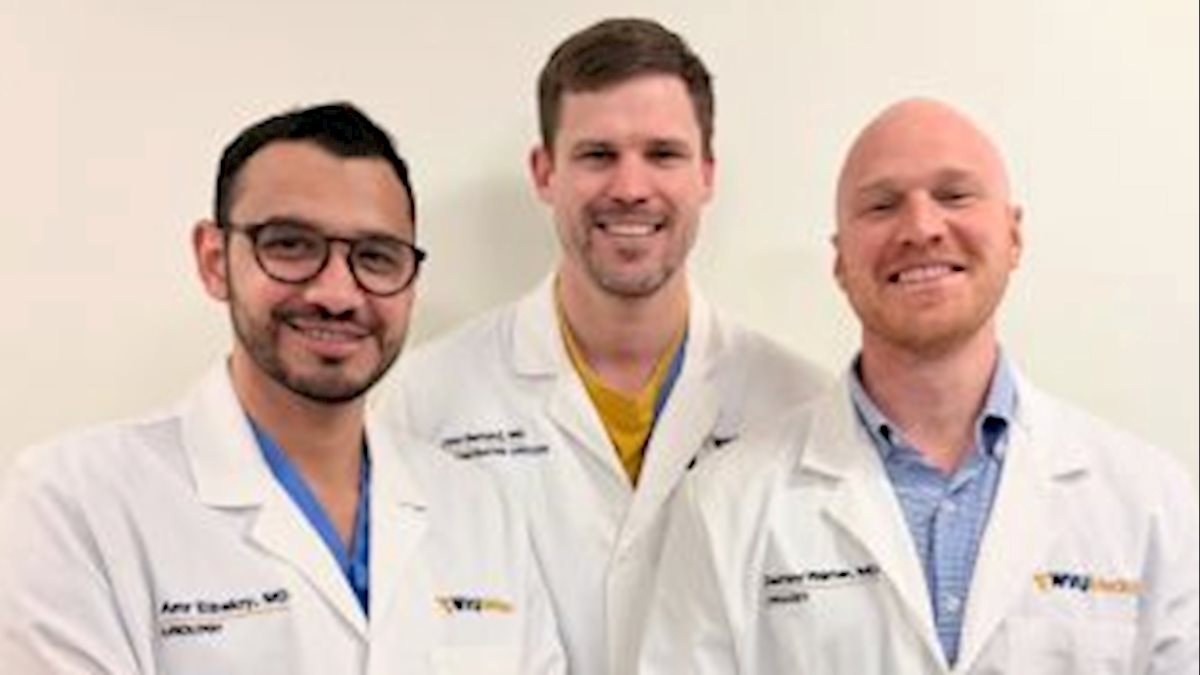
Pictured from left are Division of Reconstructive Urology faculty Amr Elbakry, MD; John Barnard, MD; and Zachary Werner, MD.
Patients with complex urologic conditions are benefiting from expanded access to minimally invasive surgical care at WVU Medicine J.W. Ruby Memorial Hospital, where reconstructive urologist Amr Elbakry, MD, recently completed his 100th single-port robotic procedure.
Dr. Elbakry, a fellowship-trained reconstructive urologist at WVU Hospitals, has helped advance the use of single-port robotic surgery for patients requiring complex reconstructive procedures involving the urinary tract.
As WVU Medicine’s robotic surgery program has continued to expand, the Division of Reconstructive Urology has established itself as a leader in offering innovative treatment options.
Single-port robotic surgery allows surgeons to perform complex procedures through a single small incision. For many patients, this approach can reduce pain after surgery, shorten hospital stays, speed recovery, and leave less visible scarring.
It also gives surgeons another option alongside traditional open surgery and multi-port robotic surgery, allowing them to choose the approach that best fits each patient’s needs.
“This milestone highlights Dr. Elbakry’s expertise and his dedication to advancing reconstructive urology within our department, Health System, and state,” John Barnard, MD, chief of the Division of Reconstructive Urology, said. “His commitment to innovation and patient-centered care has strengthened our Division and further establishes the WVU Medicine Urology program as a regional leader in complex urologic reconstruction.”
Dr. Elbakry treats a wide range of noncancerous conditions that affect the urinary system, including narrowed or blocked tubes that carry urine from the kidneys, blockages that prevent urine from draining properly, abnormal openings between organs, scar tissue that affects the bladder, and other conditions that require reconstructive surgery.
Dr. Elbakry completed advanced fellowship training in reconstructive urology at New York University under Lee Zhao, MD, a pioneer in robotic-assisted urologic surgery. As one of a select group of reconstructive urologists with advanced experience using single-port robotic surgery, Dr. Elbakry continues to help expand the role of robotic reconstructive surgery through patient care, research, and surgical education.
“Reaching 100 single-port robotic reconstructions reflects more than technical expertise,” Steven Campbell, MD, chair of the Department of Urology at WVU Hospitals, said. “It represents a sustained commitment to advancing surgical care, expanding access to innovative treatment, and preparing the next generation of reconstructive urologists.”