Federal grant helping WVU train future physicians in street medicine
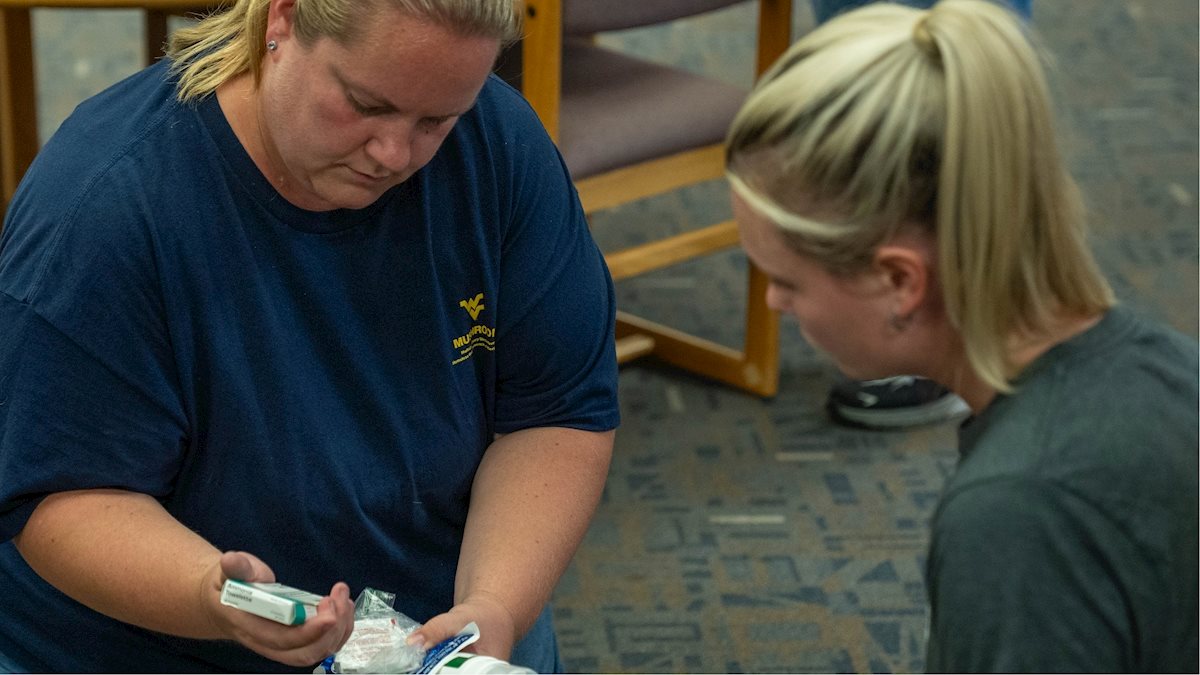
Dr. Sylwia Brooks and her colleagues in the West Virginia University School of Medicine have encountered situations that broadened the way they define social determinants of health and gave new meaning to meeting people where they are. Now, they’re setting the course to guide future primary care physicians through similar experiences as part of their formal training.
With support from a $498,605 grant from the U.S. Department of Health and Human Services, the project is a collaboration between faculty at WVU Family and Community Medicine residency in Morgantown and the Harpers Ferry Rural Family Medicine Residency Program. The team of healthcare professionals is coordinating logistics and planning curriculum for a required four-week street medicine rotation. Second- and third-year medical residents in those two programs will go into communities for their training in established and pop-up clinics, encampments and other locations where need arises. As an additional part of the project, organizers hope to develop a Street Medicine Track for residents that will cover chronic disease management, harm reduction, behavioral health and advocacy.
“West Virginia University School of Medicine Graduate Medical Education (GME) is proud to have Street Medicine as a component of the Family Medicine Residency Program because it extends comprehensive, patient-centered care to West Virginia's most vulnerable and underserved populations,” said Dr. Sarah Sofka, associate dean for GME, Designated Institutional Official and professor in the School of Medicine. “This commitment aligns with our GME mission to improve the health of the communities it serves through compassionate, community-based care while addressing health disparities and barriers to access.”
The project title, INSPIRE to Empower, builds its name on Interdisciplinary Network for Street Primary-Care Integration into Residency Education.
“We want to inspire future physicians to step out of the clinic setting and into the community to confront the realities that their patients’ populations face including lack of shelter, food insecurity and addiction,” said Brooks, assistant professor in the WVU School of Medicine Department of Family and Community Medicine. “We hope that through this immersive experience they will learn beyond traditional medical knowledge and will appreciate that healing can take many forms.”
Brooks knows those realities homeless people face. As a WVU medical student, she began her journey into community service at Milan Puskar Health Right, a free medical clinic in Morgantown, where she continues to volunteer today. She’s also accompanied students and faculty on rounds for Project MUSHROOM, a volunteer program that brings together students and clinicians for street rounds to provide care including food, water, clothing and basic medical intervention to the homeless. And, she’s seen homelessness and people who lack shelter — which she explains are two different, but similar situations — in scenarios not everyone would consider.
“Nobody plans on life happening. People don’t realize that it’s very, very easy to end up in the situation where you don’t have a home,” Brooks said. “Shelter is a very loose term. It’s not just the people who sleep under the bridge or in a camp. It’s also people who stay with their families or friends when they are left homeless because of a natural disaster or another situation. It’s not necessarily what you would consider unsheltered, but they are living under somebody else’s roof for the time being and that usually comes with barriers, not just to healthcare but also to education, obtaining employment and what you consider a normal life.”
According to the U.S. Department of Housing and Urban Development’s Annual Homelessness Assessment Report, 1,925 people were homeless in West Virginia in 2025, an increase of 8.2% from the previous year. The figure represents individuals, families with children, unaccompanied homeless youth, veterans and chronically homeless individuals. Though Brooks and some of her associates who collect similar data wonder if the numbers are higher because the specific population is difficult to locate and count.
Regardless of the number of people who lack housing or shelter, Brooks explained that on an individual level homelessness contributes to increased risk for severe chronic disease or worse outcomes, and ultimately more costs associated with healthcare utilization. The reasons can range from simply not seeking medical care to financial constraints, lack of transportation to a healthcare facility and emotional trauma.
“It’s things like that, that make me feel like it’s crucial for a physician to be able to care for a patient that doesn’t have a shelter, and to be able to evaluate and ask the questions that help us assess the social determinants of health,” Brooks said. “Our main focus is to bridge access to healthcare because in healthcare everything matters. Every question I ask a patient, no matter the setting, is going to help me provide better care.”
Assessing their needs takes collaboration across multiple fields and that’s where the “interdisciplinary” part of INSPIRE comes into play. Inside the WVU academic arena, the team will draw from the departments of Behavioral Medicine and Psychiatry and Family Medicine. On a broader geographic scale, the program will pair with the WVU School of Medicine's Eastern Campus in Martinsburg where an established Community Health and Street Medicine elective exposes students to mobile, comprehensive primary care for underserved patients experiencing homelessness, substance use disorders and mental health disorders.
“In Harper’s Ferry, WVU has a well-developed street medicine program and our Morgantown cohort will work very closely with them,” Brooks said. “The residents will do rotations across one another’s campuses as well.”
A slate of community partners includes state and local government agencies, legal groups and social workers, as well as various clinics in the Mountain State.
Working with Brooks on the grant proposal and project formulation are faculty members from across disciplines and campuses, including the School of Medicine’s Dr. Courtney Pilkerton, Amie Ashcraft, Barbara Cubic, Jun Xiang, Dr. Katie Hill, and Dr. Dana Bechtold; and Angela Goodhart, associate professor in the WVU School of PharmacyDepartment of Clinical Pharmacy.
“This collaboration with community partners will build confidence in these aspiring physicians and allow them to truly meet the patients where they are,” Brooks said.
Brooks added that she expects medical students will meet the program with enthusiasm.
“One of the things we are asked most by future residents and recent residency alumni, is whether we’re developing more community involvement with street medicine,” she said.
Brooks also hopes the program will change the narrative of how people view homelessness, not only among healthcare providers, but within society.
“Instead of seeing people or the encampments as a burden on the community, let’s look at how we as a community can step up,” she said. “I feel like new physicians being trained with first-hand experience will see how it changes their perception. I know it changed me.”
-WVU-
ls/9/21/26
MEDIA CONTACT: Linda Skidmore
Health Research Writer
WVU Health Sciences Center
Linda.Skidmore@hsc.wvu.edu